Open Ecosystem, Flexible Development
Supports CAN communication with drag teaching, offline trajectory playback, and API control. Compatible with ROS / ROS2 and mainstream simulation environments with a ready-to-use SDK.

LUMOS TOUCH R1
Lumos Touch R1 is a 6-DoF desktop robotic arm from Lumos, designed to work with the Lumos FastUMI Pro multimodal embodiment-free data-collection system. It provides a real-hardware validation platform spanning data collection, model training, policy deployment, and physical execution for imitation learning, reinforcement learning, and VLA research.
Supports CAN communication with drag teaching, offline trajectory playback, and API control. Compatible with ROS / ROS2 and mainstream simulation environments with a ready-to-use SDK.
Modular end-effector interfaces support grippers, dexterous hands, and multimodal sensors for rapidly building perception-planning-execution testbeds.
Built on integrated 6 DoF servo joints with a near-spherical workspace, 1.5 kg payload, and ±0.1 mm repeatability for tabletop experiments and fine manipulation.
Key metrics, control interfaces, and software support at a glance.
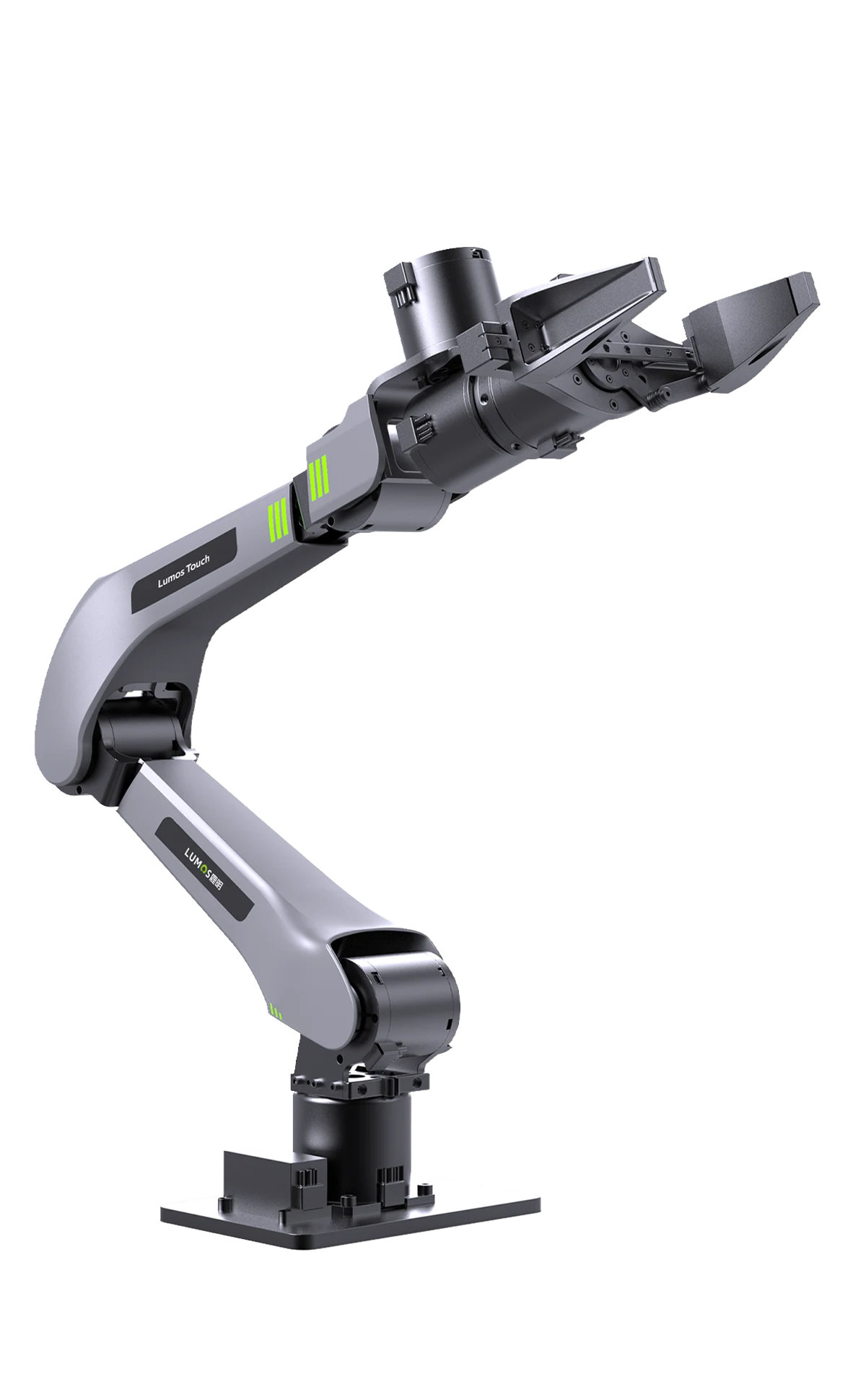
Built around real-hardware validation, policy training, and multi-device execution for embodied deployment workflows.

Validates accuracy, stability, and repeatability across tabletop precision handling, assembly, and sorting tasks.

A full-stack industrial embodied AI capability system built on three integrated pillars: scenario resources, data and model capabilities, and hardware infrastructure.